BLine
Build fast autos. Tune what the robot actually does.
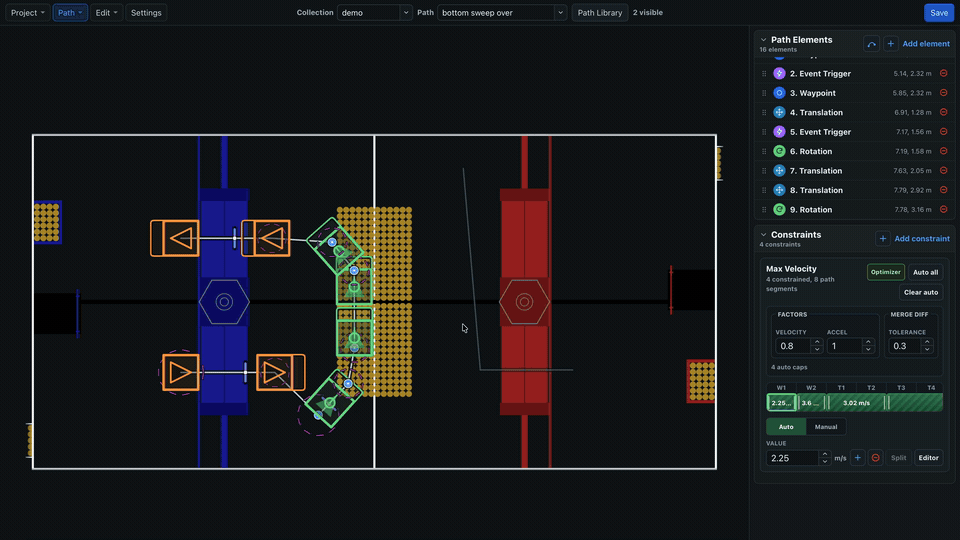
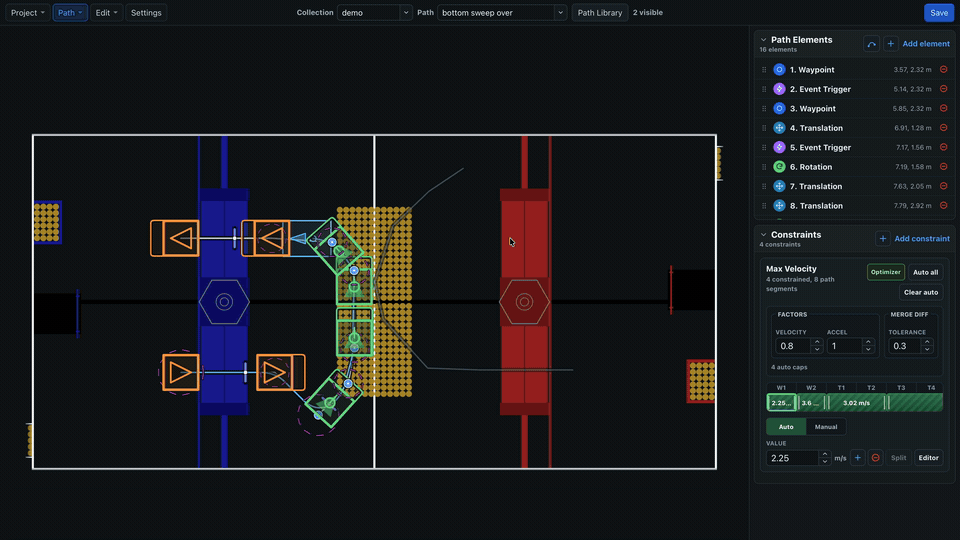
BLine is an open-source point-to-point path planning suite for FRC holonomic drivetrains. Create paths visually in BLine Web or construct them directly in Java, then follow them from the robot's live pose with a library built for rapid testing. The editor and exported JSON are a convenient authoring workflow, not a requirement.
Build your first BLine auto Try BLine Web
Competition-tested. Recommended by teams.
In 2026, teams including Code Orange, KAISER, Team SCREAM, The Blair Robot Project, Spartronics, and Smithville Tiger Trons put BLine into real robot workflows. Here is what team members reported publicly after trying it or running it in competition.
We at Code Orange firmly believe BLine is pure magic.
The tracking was super stable.
Considering how little time we had to tune our auto at home, it was super accurate.
Plus many more miracles that wouldn’t have been possible without BLine.
Easy to work with for someone of my…unfamiliarity with auto planning.
These excerpts describe individual teams' experiences. Results still depend on localization, drivetrain control, path design, constraints, and robot testing.
A proven point-to-point idea, packaged for more teams
BLine shares the broad point-to-point philosophy used in custom systems from top programs such as 2910 Jack in the Bot and 2056 OP Robotics: steer from the live robot state toward geometric goals instead of treating a pre-timed trajectory as the source of truth. BLine turns that approach into a public browser-and-desktop editor, reusable Java library, logging surface, and documented workflow rather than requiring every team to build its own follower.
The tradeoff is intentional
BLine prioritizes fast authoring, empirical tunability, and live-pose correction. It is not a time-optimal drivetrain dynamics optimizer, and a drawn polyline is not automatically physically feasible. Teams still need a trustworthy pose estimate, stable module control, safe geometry, realistic constraints, and robot testing. See Geometric and time-parameterized tracking for when each approach fits.
Two ways to create a path
| Approach | What you do |
|---|---|
| BLine Web + JSON | Draw and organize paths in the hosted editor or desktop app, preview idealized motion, export robot-ready JSON, and load it with BLine-Lib. |
| Java construction | Build a Path from waypoints, translation targets, rotation targets, events, and constraints in robot code. No editor export or path JSON is required. |
Both approaches create the same BLine-Lib Path model and use the same FollowPath command. See Create Paths in Java or Load JSON for complete examples.
The current documentation is verified against BLine Web v0.1.0-alpha.12 and BLine-Lib v0.9.1. See Versions & Support.
The 2027 Beta 2 guide describes the separate editor preview; the Beta 1 guide remains available for that release. The tutorials and editor visuals elsewhere on this site continue to cover alpha.12.
Choose your route
| Goal | Start here |
|---|---|
| Get one path running | First Path Tutorial |
| Understand the approach | How BLine Works |
| Tune a real robot | Tune Your Robot |
| Learn the current editor | BLine Web Overview |
| Integrate the Java library | BLine-Lib Overview |
| Create a path directly in robot code | Create Paths in Java or Load JSON |
| Diagnose a failure | Common Issues |
Learn by building
The recommended progression is:
- Verify pose and drivetrain frames.
- Create one straight path on the latest FRC field.
- Export and load it on the robot.
- Wire logs before changing controller gains.
- Tune translation, rotation, then cross-track control.
- Shape competition paths with constraints and handoff radii.
- Add collections, linked elements, events, overrides, and other advanced features.
Project links
- BLine Web — current browser and desktop editor
- BLine-Lib — Java robot library and Javadocs
- Chief Delphi discussion — questions, field experience, releases, and community feedback
- Full Javadocs — generated API detail
BLine is open source under the BSD 3-Clause License.